Unraveling what science really says about how weather affects pain, mood, and energy.
✅ TL;DR (3-Line Summary)
- Many people report increased pain, fatigue, and mood shifts with changes in weather—but is it supported by science?
- Research shows growing evidence for weather’s influence on inflammation, nerve sensitivity, and mental health.
- This article explores what’s proven, what’s debated, and what strategies actually help.
👩⚕️ Expert Dialogue: Dr. Monica (Neuroimmunologist) & Dr. Harris (Environmental Physiologist)
Dr. Monica: The connection between weather and symptoms like pain or fatigue isn’t just anecdotal. We’re seeing biological mechanisms—especially inflammation and barometric pressure sensitivity—come into clearer focus.
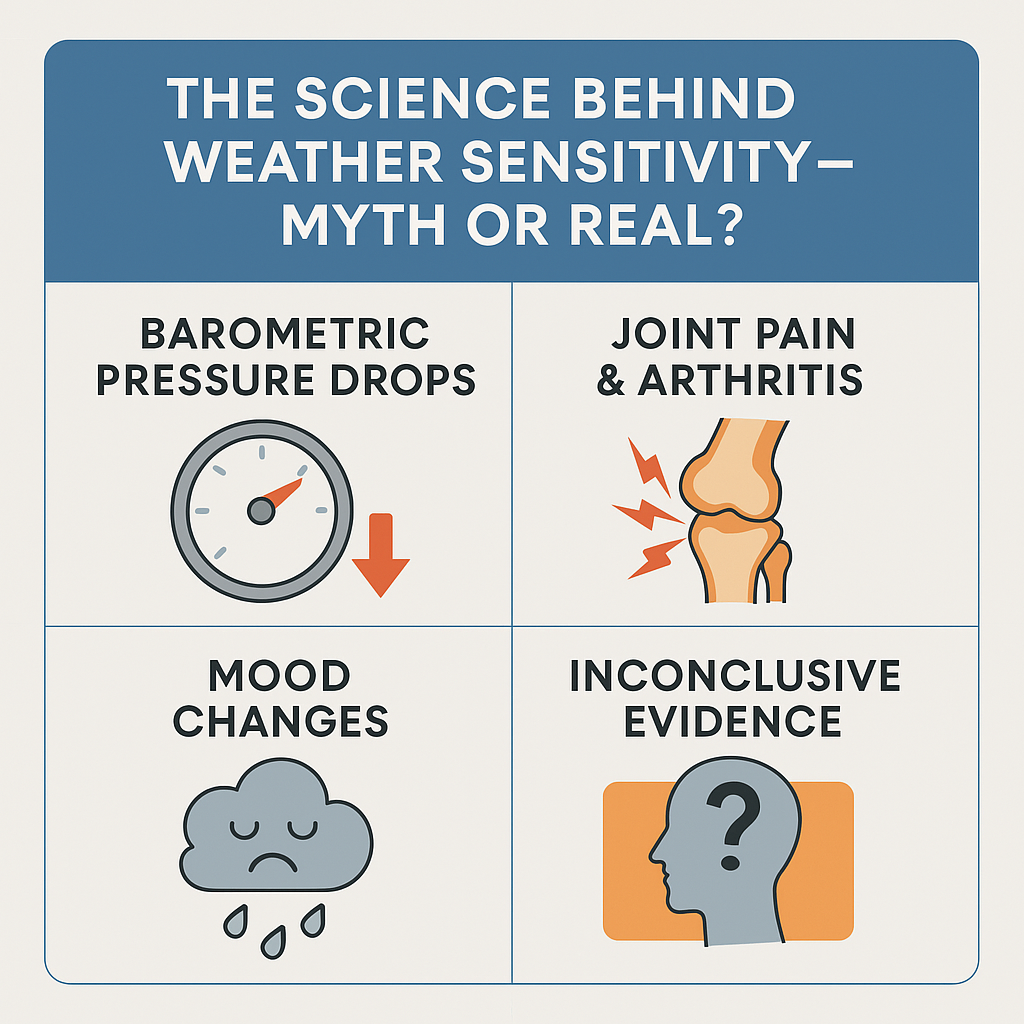
Dr. Harris: I agree. For example, low pressure seems to affect how joints expand, how nerves fire, and how our mood shifts due to circadian disruption. Even temperature and humidity affect tissue swelling and oxygen saturation.
Dr. Monica: But the skepticism remains because results are variable. Some studies show correlations, others don’t. It likely depends on the person’s baseline inflammation, existing conditions, and even genetics.
Dr. Harris: And perception plays a huge role. The brain is a predictive engine. If someone associates bad weather with flare-ups, that belief alone can amplify real symptoms via the nocebo effect.

🧬 What the Research Shows
🔹 Barometric Pressure
- Linked to joint capsule expansion and increased nerve sensitivity.
- Several studies confirm correlation with migraine incidence and arthritis pain.
🔹 Humidity & Dampness
- Affects swelling, circulation, and fungal proliferation (skin & sinuses).
- Can worsen inflammation in fibromyalgia and eczema patients.
🔹 Temperature Swings
- Rapid changes stress the nervous system.
- Cold constricts blood vessels → stiffness; heat expands → fatigue.
🔬 Weather Sensitivity – Myth or Real? Self Check
🧠 Weather Sensitivity vs. Weather Reactivity
Dr. Harris: Let’s distinguish between weather sensitivity and reactivity. Sensitivity means your body perceives and responds. Reactivity means it amplifies that signal into pain, fatigue, or mood disturbance.
Dr. Monica: Right—and that’s influenced by everything from sleep to gut health to past trauma. People with dysregulated nervous systems (like in fibromyalgia or PTSD) tend to react more intensely.
Dr. Harris: It’s also cumulative. If you’ve had poor sleep, stress, and hormonal shifts, a small weather change can hit like a truck.
🧪 Debunking the Myth (and the Stigma)
- MYTH: “It’s all in your head.”
TRUTH: While perception is powerful, physical mechanisms—like nerve sensitization and inflammatory cytokines—are biologically real. - MYTH: “No proof means no link.”
TRUTH: Absence of evidence ≠ evidence of absence. Many studies lack the granularity to detect personal weather-pain patterns. - MYTH: “Everyone’s affected the same way.”
TRUTH: Genetics, health history, age, and comorbidities determine individual sensitivity.

🧘 What Actually Helps
- Track patterns: Use apps like WeatherX or My Pain Diary.
- Predict & prevent: Hydrate early, use anti-inflammatory meals, adjust workouts.
- Support your nervous system: Prioritize sleep, stress management, gentle movement.
- Talk to your doctor: Bring your symptom-weather log to appointments.

🙋♀️ FAQ – Weather Sensitivity Explained
Q1. Is weather sensitivity recognized by science?
Yes. While not a standalone diagnosis, numerous studies support links between weather changes and symptom flare-ups, especially in chronic conditions.
Q2. What’s the difference between sensitivity and hypochondria?
Sensitivity is physiological. Hypochondria is a psychiatric condition. Feeling worse with storms doesn’t make you irrational—it makes you human.
Q3. Can I test if I’m sensitive to weather?
Start with a journal. Track daily symptoms alongside weather changes. If consistent patterns appear, you’re likely weather-sensitive.
Q4. Should I avoid going out in bad weather?
Not necessarily. The goal is to adapt, not isolate. Wear protective layers, pace activity, and stay hydrated.
Q5. What kind of doctor helps with this?
Start with a rheumatologist or neurologist. Functional medicine doctors also address environmental triggers holistically.
🧭 Final Thoughts: Believe Yourself. Then Build a Strategy.
Science is catching up to what people with chronic symptoms have long known: the weather matters.
It’s not just the rain. It’s the pressure, the humidity, the changes that feel like static in your body. Whether it shows up as pain, mood drops, or brain fog—it’s real.
The key isn’t avoiding the weather. It’s understanding your patterns and responding with intention.
Track. Adjust. Honor your body.
And when someone says, “You’re just being sensitive”—you can smile, and say: “Exactly.”


