Digital Overload Part - 2
TL;DR: Dopamine Hijack & Your Brain
Ever felt hooked on your phone for no reason? That’s not your fault. It’s dopamine. This post dives deep into how apps are rewiring your brain’s reward system and what you can do to regain control without going off-grid.
Reader Question: “Why do I check my phone even when I don’t want to? It’s like my fingers have a mind of their own.”
🧬 Expert Dialogue: When Design Becomes Addiction
Emma (Behavioral Coach): Dr. Rivera, I keep hearing about how our phones hijack dopamine. What’s really happening?
Dr. Alan Rivera (Neuropsychologist): Think of dopamine as your brain’s motivational currency. It’s released when you anticipate rewards—not just when you get them. Modern apps exploit this by offering unpredictable rewards: likes, messages, new content...
Emma: Like a slot machine.
Dr. Rivera: Exactly. That unpredictability keeps the dopamine flowing. Apps are engineered to mimic addictive behaviors—endless scroll, autoplay, alerts. Your brain starts craving the next hit before you’ve even finished the last one.
Emma: So the brain rewires itself to need that feedback loop?
Dr. Rivera: Yes. Over time, the natural reward pathways get suppressed. Things that used to bring joy—nature, real connection—can feel less stimulating. This is the “dopamine deficit state.”
Emma: That sounds scary. Can we undo it?
Dr. Rivera: Absolutely. Neuroplasticity is real. You can restore balance—but it takes intention.
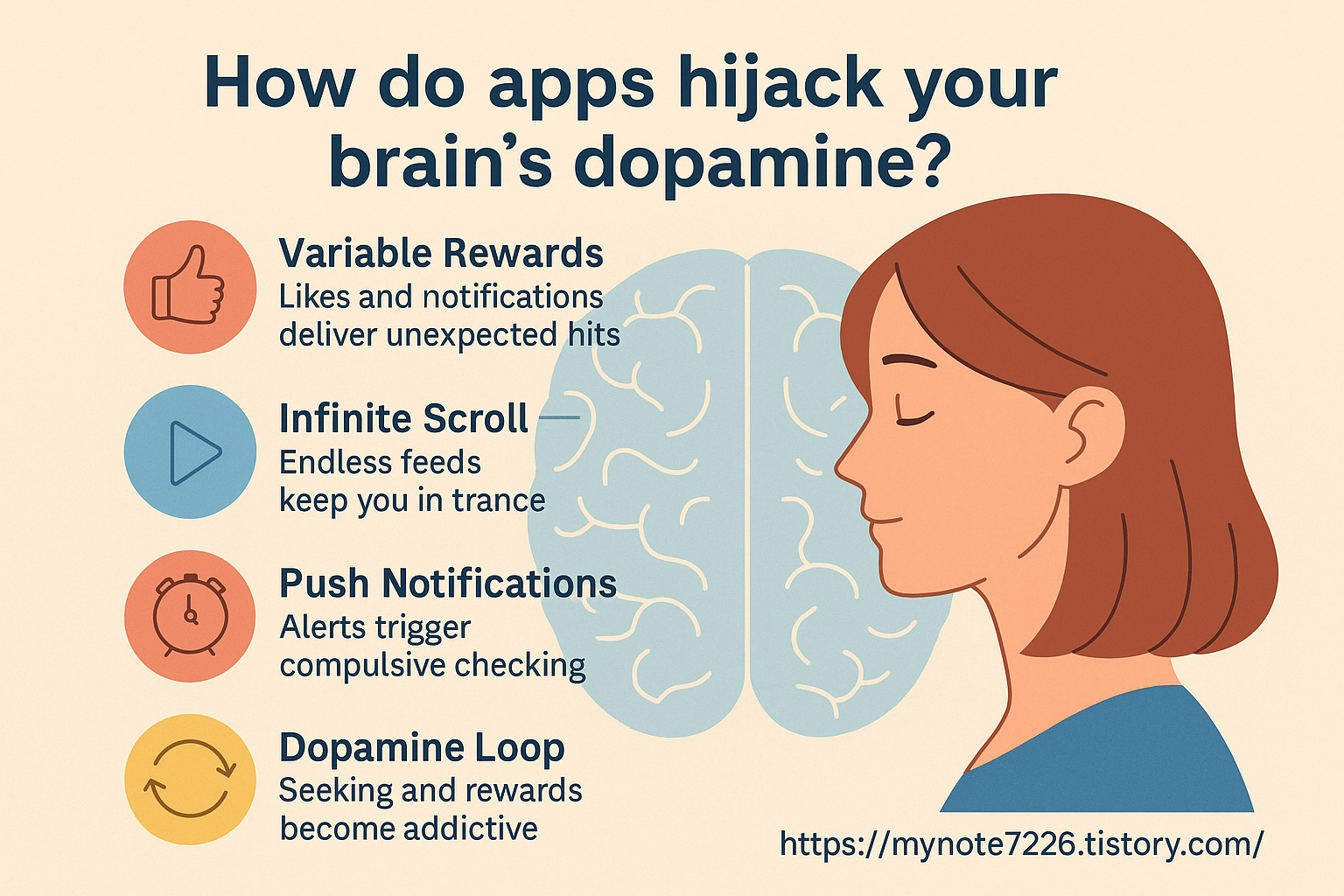
alt text: "Infographic showing how apps hijack dopamine through variable rewards, infinite scroll, push notifications, and the addictive dopamine loop, with a brain and calm woman illustration. Includes blog URL mynote7226.tistory.com."
🎮 Self-Check: Are You in the Dopamine Loop?
Take this 10-question quiz to evaluate if your brain is stuck in a dopamine-seeking feedback loop caused by digital apps and stimuli.
🔍 The Science of Dopamine Hijack
- 📱 Variable rewards: Getting 5 likes vs 50 is unpredictable—this keeps you hooked.
- 🧠 Reward prediction error: When reality exceeds expectation, dopamine surges. Apps are designed to create this.
- 📉 Baseline dopamine drops: The more you chase small digital highs, the less natural joy you feel from non-digital activities.
- 🕰️ Delay discounting: Your brain learns to prefer instant rewards over meaningful long-term ones.
🔥 Symptoms of Dopamine Dysregulation
- 🚨 Need to check your phone every few minutes
- 🚨 Feeling bored during natural activities (reading, walking, talking)
- 🚨 Mood crashes after screen use
- 🚨 Scrolling past bedtime, even when tired
Emma: Dopamine isn't evil—it’s being manipulated. This isn’t about shame. It’s about awareness.
alt text: "Cycle chart explaining the dopamine addiction loop: trigger, craving, scrolling, small reward, and repetition, illustrated with icons and wooden background. Blog URL mynote7226.tistory.com included."
📘 Reader Story: Maya’s Wake-Up Call
“I realized I had a problem when I couldn’t get through dinner with my partner without scrolling. He called me out gently, and I broke down crying. I didn’t want to be that person. That night, I deleted 6 apps and made a plan. I started waking up before my phone.”
❓ FAQ: Real Talk About Dopamine & You
1. Do I have to delete all my apps?
Not necessarily. You need to interrupt the loop, not eliminate all tech. Start with boundaries and screen-free zones.
2. Can dopamine really change from tech use?
Yes. Studies show altered dopamine response in people using social media for over 3 hours/day. But it’s reversible.
3. Why do I feel empty after scrolling?
Because you’re feeding a craving, not a need. The reward is shallow—and your brain knows it.
4. What helps reset dopamine levels?
Nature walks, cold showers, deep conversations, and doing nothing. Part 5 will guide you through a full 7-day plan.
5. Is this just a willpower problem?
No. This is design warfare. Apps are engineered to beat your willpower. That’s why you need tools, not guilt.
alt text: "Visual comparison showing before and after dopamine reset, with differences in focus, sleep, mood, and confidence illustrated by a thoughtful woman and purple background."
🔁 Internal Links You’ll Want to Explore:
- Part 1 – What Is Digital Overload?
- Silent Inflammation Series – Brain Fog Edition
- Circadian Nutrition – Dopamine & Diet
🌐 External Readings You Might Like:
🔗 Navigation
- ⬅️ Previous: Part 1 – What Is Digital Overload?
- ➡️ Next: Part 3 – Screens and Sleep: Melatonin Disruption and Fixes
- 📚 All Posts in the Digital Detox Series
💡 You Are Not Broken
You’re not lazy. You’re not weak. You’re just human in a hijacked system.
Let’s reclaim your clarity—one scroll at a time. 💙


